
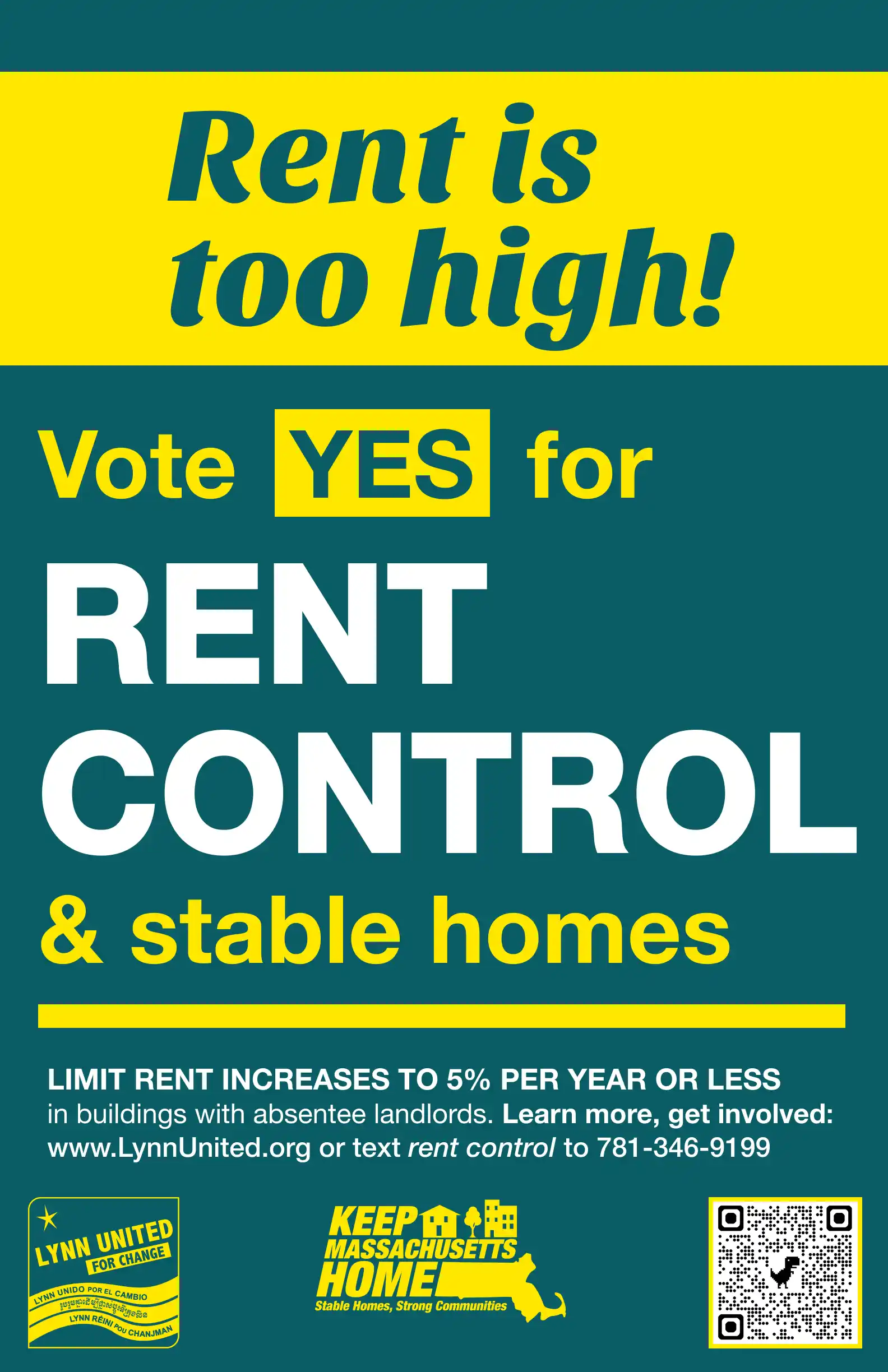
- Get involved: Lynn residents, click here to sign up to help win rent control! There are lots of ways to help – let us know how you'd like to be involved. No experience needed! If you're from anywhere else, sign up here to join the effort.
- See below on this page for responses to some common questions.
Responses to questions and concerns
- Will rent control cause my property taxes to skyrocket?
- No. This claim – from a segment of the real estate industry opposed to rent stabilization – is based on a deeply flawed and misleading study by the Greater Boston Real Estate Board. It has been thoroughly debunked here. Read the full analysis here [PDF] to understand in detail how this biased study misused data to support the fearmongering campaign. Clear evidence cited in the analysis includes "A long-term study of 74 rent-controlled cities in New Jersey [that] found no significant impact on property values."
- Is there a summary of why rent stabilization is urgently needed
- Yes. Use these links to learn more about why rent stabilization is needed and how it would benefit people across the state and in your area.
- Will rent control stop the production of new housing?
-
- No. Modern rent stabilization policies like the ones being considered in Massachusetts exempt newly constructed buildings from the rent limits for an initial period of operation, ensuring production of new housing and rent control can work together to promote the well being of our communities.
- It's well known what factors actually limit the production of new homes: high interest rates, exclusionary zoning, and elevated costs of materials.
- We have not had rent control in Massachusetts for over thirty years, and during that time our state has failed to produce enough housing. Rent control is not the factor holding back production! In fact, "multifamily building permits actually reached their height in the mid to late 1980s [before rent control was banned in the state]" (per Rent Matters: What are the Impacts of Rent Stabilization Measures?, a study by the University of Southern California Equity Research Institute).
- The Massachusetts AFL-CIO, which includes building trades unions as key members, endorsed the rent stabilization bill in the State House ("An Act enabling cities and towns to stabilize rents and protect tenants," S.1447 / H.2328). There's no way that would have happened if these policies really threatened construction of new housing. This is just an excuse from segments of the real estate industry trying to preserve their ability to raise rents and price gouge without limits.
- More and more studies are showing that rent stabilization policies do not negatively impact production in the manner opponents suggest. In some ways, the rent control debate is similar to debates about the minimum wage or raising taxes on the very rich. Big businesses like to say that increasing the minimum wage will cause job losses. And some very wealthy individuals claim that raising taxes on the rich will cause them to move away to escape paying. But the more research is done on actual minimum wage increases, the more proof we see that the jobs do not really disappear. And the predictions that millionaires will leave en masse to escape new taxes on the very rich never prove correct.
Some real estate speculators and developers are doing the same with rent control. Openly stating that they want the right to price gouge and drastically increase rents without a limit wouldn't be too popular. So they instead claim that they (or "developers" more generally) will stop building new homes if rent control is implemented. It's a scare tactic to preserve maximum profits, and it's not based in reality. See Our Homes, Our Future: Economists Are Rethinking Rent Control [PDF] - Many empirical studies show that rent stabilization does not negatively impact construction, for example:
(72) Pastor M, Carter V, Abood M. Rent Matters: What Are the Impacts of Rent Stabilization Measures? USC Dornsife Program for Environmental and Regional Equity; 2018. https://dornsife.usc.edu/eri/wp-content/uploads/sites/41/2023/01/2018Ren...
(23) Ambrosius JD, Gilderbloom JI, Steele WJ, Meares WL, Keating D. Forty years of rent control: Reexamining New Jersey’s moderate local policies after the great recession. Cities. 2015;49:121-133. doi:10.1016/j.cities.2015.08.001
(27) Gilderbloom J, Ye L. Thirty years of rent control: a survey of New Jersey cities. J Urban Aff. 2007;29(2):207-220. https://journals.sagepub.com/doi/10.1177/004208168101700201
(111) Zuk M. Rent Control: The Key to Neighborhood Stabilization? Othering and Belonging Institute. September 9, 2025. Accessed August 14, 2025. https://belonging.berkeley.edu/rent-control-key-neighborhood-stabilizati...
(112) City of Berkeley Planning and Development Department. Rent Control in the City of Berkeley, 1978 to 1994: A Background Report. City of Berkeley; 1998. Accessed August 14, 2025. https://rentboard.berkeleyca.gov/sites/default/files/2022-01/Historical_...
(113) Baar K, Burns P, Flaming D. San José ARO Study: Study of the Apartment Rent Ordinance of the City of San José. Economic Roundtable; 2016. doi:10.13140/RG.2.2.19074.12480
(114) Smith W, Teitz M. Rent Control in North America and Four European Countries: Regulation and the Rental Housing Market. Routledge; 2020. doi:10.4324/9780429338465
(115) Mason JW. Considerations on rent control. The Slack Wire. November 14, 2019. Accessed February 27, 2020. https://jwmason.org/slackwire/considerations-on-rent-control/
(116) Slater T. From displacements to rent control and housing justice. Urban Geogr. 2021;42(5):701-712. doi:10.1080/02723638.2021.1958473
- Additional studies have found that repealing rent stabilization does NOT lead to an increase in housing production, for example:
(21) Autor DH, Palmer CJ, Pathak PA. Housing market spillovers: evidence from the end of rent control in Cambridge, Massachusetts. J Polit Econ. 2014;122(3):661-717. doi:10.1086/675536(117) Blumgart J. In defense of rent control. Pac Stand. Published online April 1, 2015. Accessed August 20, 2025. https://psmag.com/economics/in-defense-of-rent-control/
(118) Collins TL. Rent Regulation in New York: Myths and Facts. Published online 2016.
https://mvtenantscoalition.wordpress.com/wp-content/uploads/2016/05/myth... - Above studies referenced in The Health Benefits of Rent Control: A Policy Brief for Public Health Practitioners
- Isn't building more homes the real solution?
- We need rent control AND production of new homes. Neither one is sufficient alone, especially since building at the scale required will take decades. And many new units will be far too expensive for average Lynn residents. Thanks to the segmented real estate market and a state still highly segregated by class and race, new units in Lynn will often be targeted at people from other areas and will not ease housing pressure through "filtering." The real solution is to implement rent control as we also encourage new production.
- Will this hurt small scale landlords?
- Rent stabilization will not hurt responsible small scale landlords. Owner-occupant landlords in buildings with 4 units or less will be totally exempt from the policy. And local medium-scale landlords will benefit since they will not have to compete with predatory investors looking for quick profits at any cost rather than the gradual rent increases, stable neighborhoods, and positive local relationships that responsible local owners should value.
- Other questions and more info
- For answers to other questions and more in-depth responses to some of the issues discussed above, check out this FAQ page.